Free tool
Know which resume you sent to whom
A spreadsheet can hold the company, the role and the date. What it cannot tell you, six weeks later when a recruiter finally calls, is what your resume said on the day you applied — because you have edited it eleven times since.
Free with any account. No limit on applications, and you can export everything to CSV whenever you want it back.
What it records that a spreadsheet does not
Every application can carry the resume you sent it — not a link to whatever that document has since become, but the exact version, pinned the moment you marked the application as sent. Edit the resume afterwards and the tracker says so, plainly: you have edited this since you applied.
That is the whole reason this lives inside a resume builder rather than beside one. Nothing else on your side of the conversation knows both halves.
The posting sits on the row too, so you can check how well that resume answers it — free, no model, term by term — and tailor a copy to it if the gaps are worth closing.
The numbers, and where they stop
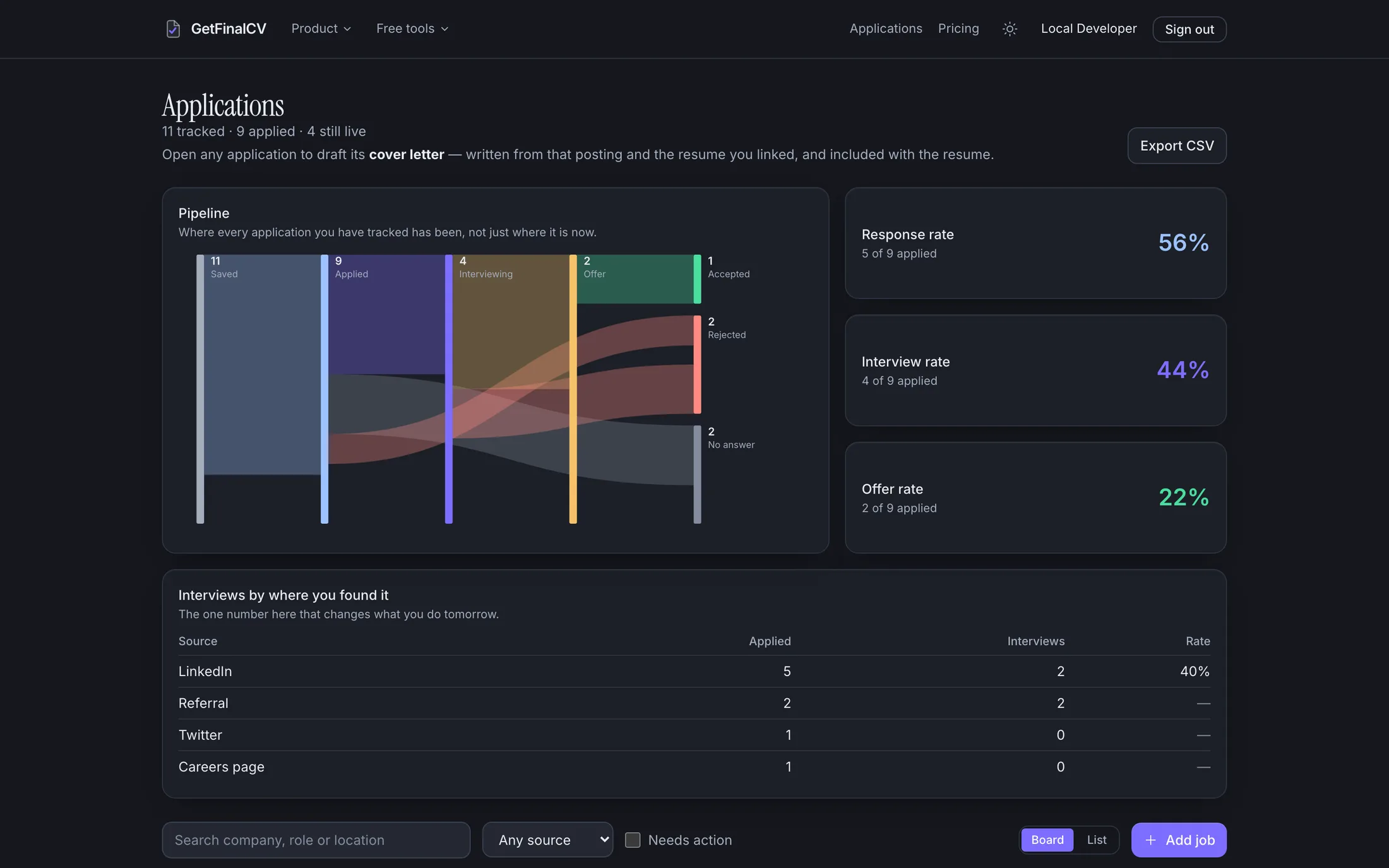
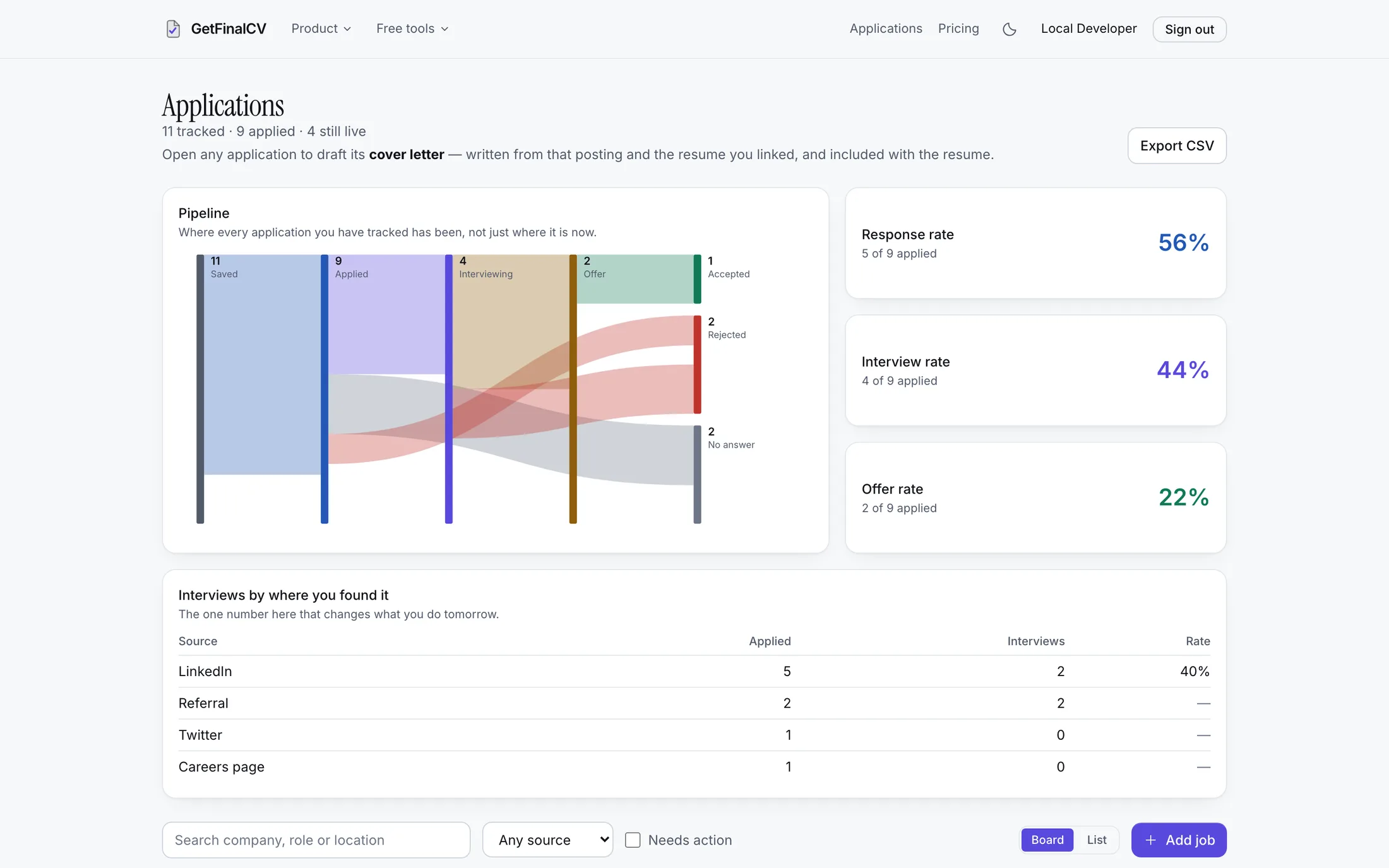
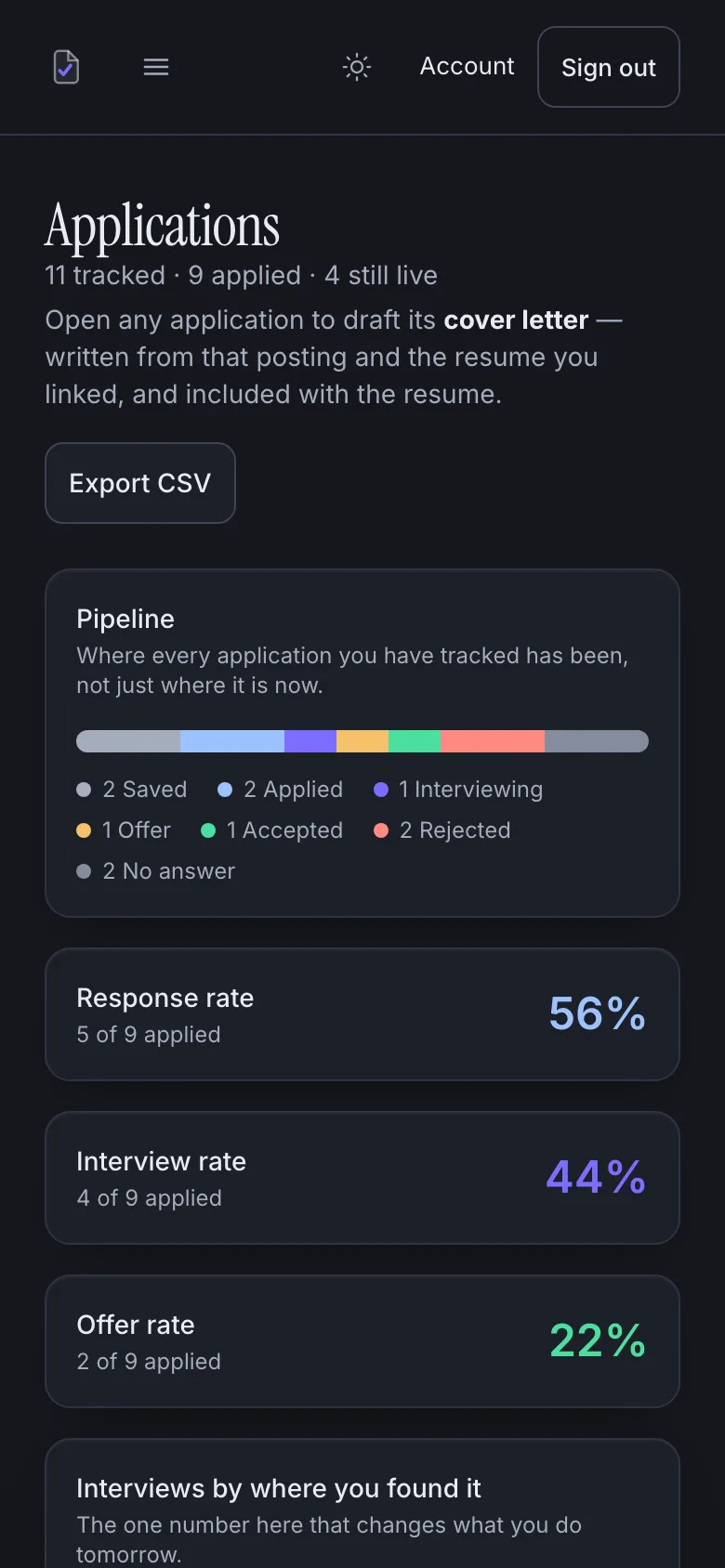
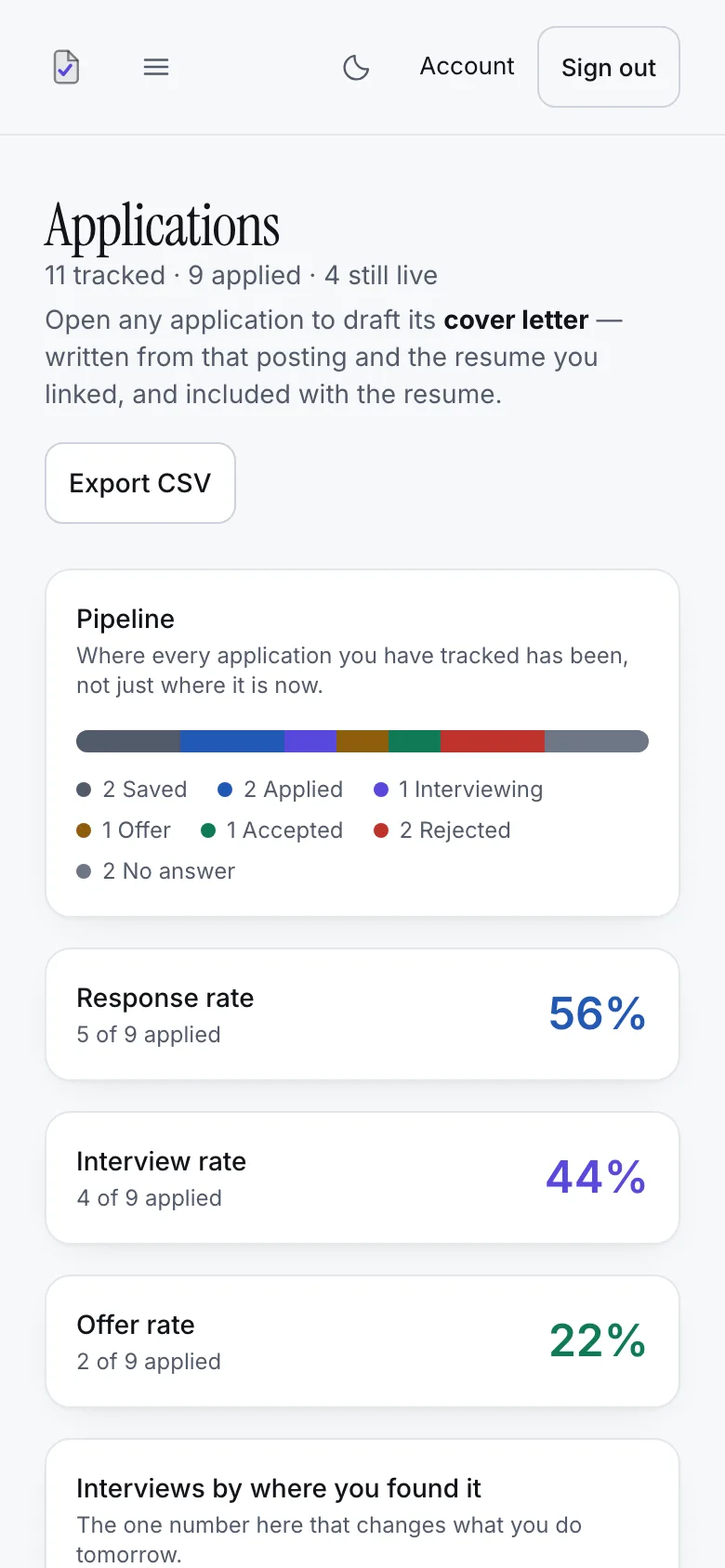
Response rate, interview rate and offer rate, each shown with the number they were worked out from — 6 of 18 applied, not a percentage floating on its own. A rejection counts as a response and silence does not, because “nobody replies” and “people reply and say no” are two different problems with two different fixes.
Below 5 applications there are no percentages at all — just the counts, and a line saying how many more are needed. A 33% interview rate worked out from six applications is the number two wearing a big font, and we would rather show you nothing than something that precise and that wrong.
The one that tends to change what people do next is the breakdown by where the job came from. Seeing Referral 4 of 5 against LinkedIn 2 of 31 in the same table is usually more useful than anything a resume score will tell you.
What it does not do
It does not email you reminders. You can put a follow-up date on an application and it will be flagged when you open the tracker, but nothing lands in your inbox. We would rather say that here than have you find out by missing a follow-up you thought was covered.
It does not fill in applications for you, and there is no browser extension. Adding a job is you typing a company and a role.
It does not read job boards. You paste the posting if you want the matching; we do not fetch it.
Your data
Everything you put in comes back out as CSV, on one click, with no ceremony. Delete an application and it goes; delete your account and all of it goes with it (privacy policy).
The tracker is free with any account and is not metered in any way — no cap on applications, no counting, nothing that expires. It is not what we sell. What we sell is the download.
Start
It takes about a minute to catch up
Add the jobs you have already applied for, mark where each one got to, and the pipeline draws itself.